Motorcycling in a group
How to ride safely and have more fun!
Lucy England
It can be really fun riding in a group of like minded motorcyclists, heading for a groovy destination together, with a nice stop for refreshments at your meeting point. But there are also a few hazards to look out for too, and a little attention to detail at the beginning, and along the way, can make all the difference between a peaceful safe and fun ride and a stressful experience.
Some things you can do will make your ride better. It is good to stick to a staggered lane formation and to use recognised hand signals, which you all know, for clear communication along the way. Communication is the key to an enjoyable ride and this may be by tapping your brake lights to show when you are slowing down, beeping your horn or using a helmet intercom system to talk to each other. It's also a good idea to carry a repair and tool kit so that you can fix minor issues along the way and a first aid kit in case of minor scratches or injuries which might occur – obviously if anything major happens you should get medical aid immediately.
Formation riding
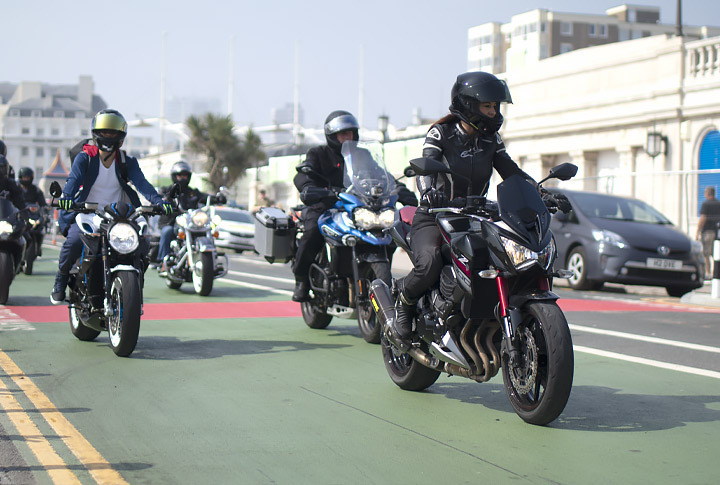
Riding in staggered double file is a good way to travel. The group leader stays in the left third of the lane, next rider a couple of seconds behind in the right third and the rest of the group alternating that pattern down the road, means that each motorcycle has room to maneuver and has more time to get out of any awkward situations should anything untoward happen to any of the bikes in the convoy. Keeping the proper gaps between machines means that if there is a need for sudden braking the bikes won't bunch up and, hopefully, will have more time to peel off should any unforeseen accidents happen. Avoid a side by side formation as this leaves no open road to head for if an accident occurs. Obviously, if the weather closes in, then it's advisable to allow longer stopping distances between bikes, and it may be better to move to a single file formation.
Pre-ride checks
Sensible bike maintenance in advance, also helps to pre-empt any potential mishaps and a T-CLOCS (Tyres, Controls, Lights, Oil, Chassis, Stands) check is always advisable.
Look at your chain to make sure it is in good condition and is clean, without dirt and grit in it which can grind away as it moves, and eventually cause serious wear. Give it a good regular clean and lubricate it so that it slides around smoothly and is protected from water ingress from wet winter roads. Examine your chain tension regularly too, as a chain which is too loose can wear the sprockets out.
Check your spark plugs too from time to time, to make sure that they are not worn and that the electrical contacts are still clean and in tip top firing condition. Carry a spare plug, ready, and gapped correctly, just in case.
Take a spare fuse with you just in case of electrical failure.
Have a good look at your tyres before you travel as well. Make sure that they are not too worn and/or cracked and that they don't have any sharp objects embedded in them which might cause a flat when you're out on the road. If just one of the group has a repair issue it can ruin the whole trip for everyone and as everyone knows a blow out on the road can cause an accident.
Keep your battery well charged. Ideally at 90% charge so that there is plenty of juice in it to complete any journey and get you safely home, even if it isn't charging properly on the road.
Make sure your brakes are working properly. Check the brake fluid levels are above min – it's a good idea to change the brake fluid every year or two, in case water has got into it which can lead to brake fade. Inspect your brake pads to make sure they are the requisite thickness so as to give you good grip and stopping power. Make sure you allow extra time for braking when riding in a group, especially if it is wet, icy or really hot.
Test that all your lights – indicators, headlamp and tail light and brake light are in good working order. Ensure that they are clean and free from dirt and dust. Ride with your lights on at all times
Make sure that everyone in your group has proper equipment with them including reflective and waterproof clothing in case the weather closes in. Plus snacks and water to stave off low blood sugar.
Hand signals
Use hand signals to communicate between riders and obviously these are all done with the left hand so as to keep the right hand on the brake and throttle at all times.
Some useful hand signals:
Slow Down - left arm down with palm down and move the forearm up and down
All Stop - left arm straight out, bend elbow down 90°
Speed Up - left arm up at 45°, palm up and scooping motion forwards
Single File - left arm vertical index finger pointing up
Hazard On The Left - left arm down at 45° pointing left
Hazard On The Right – extend right leg, and point the foot right
Bikes behind the leader who observe the signals should repeat them to apprise the riders following behind of the potential hazard or group movement.
It is also a good idea if there is anything which is important to your particular group to decide on some specific signals and learn them. For example, comfort break could be a thumbs up to the chin and think of any others which might be useful for your group.
Pre-ride group chat
Make sure that you make the time for a pre-ride briefing in which you can discuss the route, the places you plan to stop, who is leading and who is the back marker. You can also revise the hand signals and make sure everyone is aware of what they mean, especially any newer members of the group. Exchange contact details and ICE details so that you can call each other and anyone in case of a hiccup or an emergency and make sure everyone's phone is fully charged.
Some groups these days can use Bluetooth to communicate along the way, but the main form of communication should be hand/arm signals and brake taps, as Bluetooth can fail or be a distraction, but arm signals won't be either.
Leader of the pack
Ideally the leader will be experienced in the role and signal any hazards early to give the group time to react. The hand signals may even be of use to car drivers and lorries on the road so that they know what the motorcycle group is likely to be doing. Try to ride in a clear and predictable manner so that your bike's 'body language' is clear to all road users nearby and keep the group together, not leaving anyone behind.
If you stick to the basic rules of group riding you will have a lovely, safe and enjoyable time on your travels. Bon Voyage!



 EN
EN TH
TH UK
UK