Riding your motorcycle in fog
How to ameliorate the risks
Lucy England
There is always plenty of fog around in the winter causing bad visibility. Fog poses hazards for all road users, but particularly for motorcyclists. For example the light from your headlights can come back at you as glare reflecting off the fog, reducing sight-lines rather than helping you to see. Plus your visor can mist up in the ambient vapour, and there are no windscreen wipers to clear them.
Hazards
Bad visibility, obviously, is a major issue in foggy conditions and this is hard for motorcyclists. Fog reduces visibility in many ways. Contrast, spatial awareness and depth perception can all be distorted in the fog. Things can suddenly loom up out of the gloom, invisible until you are right upon them, with no distance vision through the murky air. It is hard to make out exactly what you are looking at sometimes too, on foggy days. Your vision can play tricks on your brain in the fog, as the visual cues are less clear.
On a motorcycle you have no windscreen wipers on, or defoggers inside, your helmet, so it is hard to clear moisture from your helmet if it condenses on or in it. That, combined with your breath inside the helmet, can cause a serious visibility issue for you in tricky weather conditions.
There is also a problem with humidity when it's foggy. All the moisture in the air can dampen your brakes and leave a slick damp film on the asphalt which can cause variations in your motorcycle's handling, so take extra care and ride advisedly.
Some safety measures when riding in fog are:
Don't be tempted to use your high beam, thinking it will give you better visibility when it's foggy. Water droplets suspended in fog actually scatter light, and the high beam pushes out more light at a higher angle, so it can cause back-glare reflecting back into your eyes from the wall of fog. If you stick to your low beam it is angled downwards, so will light up the road surface rather than illuminating the clouds of fog ahead of you.
Fog lights are also good, as they are low down and are wide and flat to light up the near field and the road surface, so they don't cause as much reflected glare – this is what they are designed for. It doesn't really matter what colour your lights are, yellow or white doesn't make a huge amount of difference, it's the angle and aim of the lights which are the salient factors.
If you are out and about and want to check the angle of your headlight beam, park your motorcycle on level ground around 5m from a plain wall. Shine your headlight on the wall – the low beam cut off should be 5-10cm lower than headlamp height on the wall. Check it again if you are taking a pillion or a lot of heavy luggage as this will affect the angle, if the back of the bike is lower the headlamp angle will be tilted up.
Clean Machine
Make sure that you have clean lamps and indicators – get the grime of the road off them with detergent and a cloth. Clean lamps make a big difference, as do reflectors, as a safety measure. Reflectors are best just lightly dusted so as not to damage the reflective surface. It is not necessary to get extra bright, high lumen light bulbs, as these are just likely to cause more reflected glare and dazzle oncoming traffic which will also be struggling to see through the fog. The aim of your lights is far more important than the brightness.
Fog lamps are a good idea but they need to be mounted low on the motorcycle and aimed down and outwards towards the edges of the road. They should light the road up in front of you not the clouds of fog ahead.
How to keep your helmet fog free
Warm damp breath condenses on the inside of your cold visor creating a multitude of micro droplets. One good thing to help with this is to use an anti-fog coating which spreads the moisture into a transparent sheet so keeps visibility good. Also obvious, is that good ventilation inside your helmet really helps, so open the chin or vents and let vapour out by opening the visor when the opportunity arises.
It helps to keep your visor clean inside and out, so that droplets don't stick to the dirt.
Slowly does it
Remember that if it is foggy your visibility will be significantly reduced so you need to increase your stopping distance in order to be safe and to be able to stop in time. Read the road as carefully as you can by watching the cat's eyes and the kerb to keep yourself on the straight and narrow, and stay frosty for other traffic which may be harder to spot in the murk.
Try not to overtake as well, this is always more risky in bad visibility and if it is not essential, is best avoided.
Try and check these things before you set off on a foggy day:
* Make sure that your battery is working fine.
* Check that all your lights, indicators and brake light are in good working order and your headlights are set to low beam.
* Ensure that your visor is clean, both inside and out, as smears can catch the light and impede visibility. Use an anti fog cleaner and carry a cloth to wipe your visor if it gets too wet or smeary. This is particularly relevant in these days of LED super bright dazzling headlights, as a dirty visor can make a lot of difference to your ability to see in the dark. If you find yourself being dazzled by oncoming traffic, keep glancing at the kerb on your left to keep yourself straight and on the road and help your eyes cope with the dazzle.
* Make sure your Hi-Vis and reflective items are all clean, so that you can be spotted by other vehicles more easily in the fog.
* Check your tyres to make sure they are in good condition with enough tread and without any sharp embedded objects in them.
* Make sure your electrics are all working and that all your fluids are all topped up – same drill as you would use for any winter ride in fact.
* Take a small emergency kit with you as well, plus a torch, capsule toolkit and emergency triangle in case of breakdowns.
*Always fully charge your phone as well in case you need to contact anyone in the event of any problems.
Raincheck
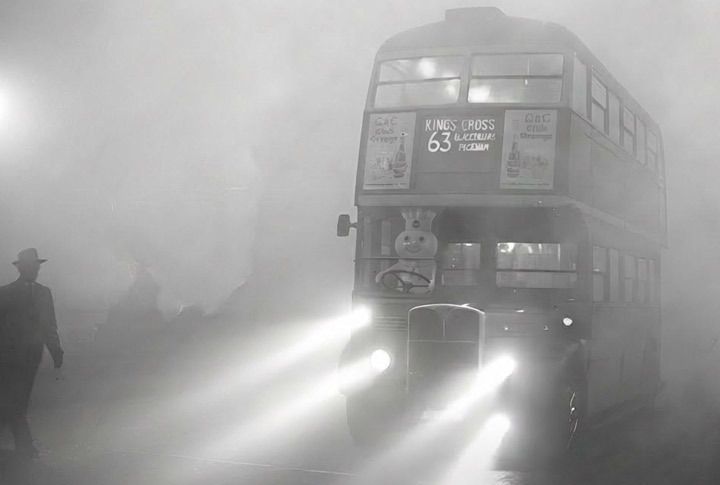
Bear in mind that it can be prudent to leave the road and pause your journey if the weather conditions close down altogether. Occasionally the mother of all fogs descends, like the London pea soupers of old, thankfully not as frequent as they used to be. If this should occur then it is wise to be circumspect and abort or raincheck your journey until conditions are more favourable. It is not worth the risk of riding in dangerous fog and is always better to get there later, or on a different day, rather than make a journey in bad visibility and take risks.
Riding in reduced visibility, by its very nature, increases the ordinary riding risks. This much is pretty obvious. So try and employ the advice and use common sense to mitigate that risk if you can.
Happy riding! Any foggy tips we've missed? Let us know at
[email protected] or on facebook...



 EN
EN TH
TH UK
UK