Teaching Old Dogs, New Tricks
The CBT revisited by experienced motorcyclist Dave
Dave Newman
Earlier this year it occurred to me that I had been riding bikes on the road for 50 years. A bit of a milestone. How many miles? How many gear changes? How many punctures?
These days I cycle more than ride my motorbike. My motorbike is used, more or less for trail riding or longer off-road forays both here and abroad.
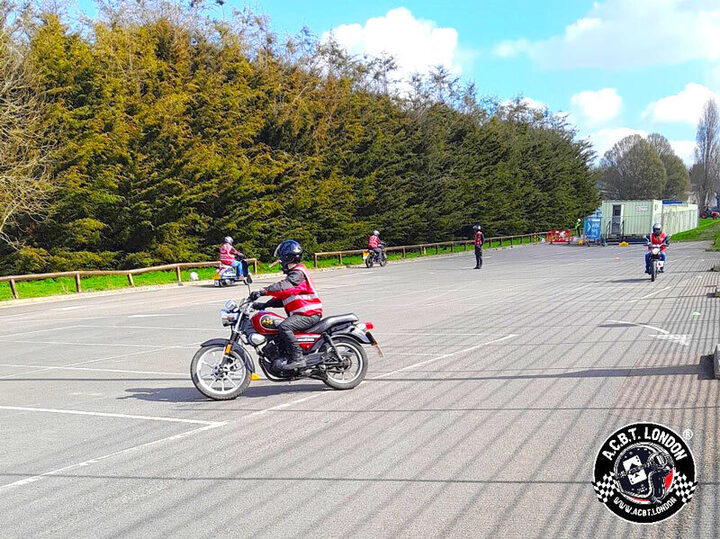
Cycling is easier because I live in London. Part of a regular route of mine takes me past a car park used for CBT. I’m talking Compulsory Basic Training as opposed to Cognitive Behaviour Therapy. That would be a whole different story!
Watching those people learning got me reflecting that I have never had any training to ride on the road. For people of my ageing generation there was nothing compulsory. We just bought a bike up to 250cc, tied some “L” plates on and away we went. Maybe a mate of dad's would give you some advice, but more often you just figured it out for yourself.
Beezer
For me it was a BSA C15 250 that I bought as soon as I left home at 18. I had already learned to drive a car and had a Raleigh Roundabout pedal moped at 16, so I understood the basics. I still fell off 2 or 3 times in the first week or so, but luckily without too much damage except embarrassment, bruises and twisted bars etc.
I am not against the idea of training at all. I don’t assume because I have survived that it would not have been beneficial. Also, I realised that apart from anecdotal stories, I knew precious little about the what the training entails or indeed, how the full motorbike test has changed.
The significant development of motorbikes arriving from Japan changed everything for motorbike riding. Especially with smaller capacity bikes. Young people began to damage themselves at an increasing rate on the F-A-S-T two stroke 250’s. The government’s reaction to the outcry from a horrified public was to halve the engine capacity for learners to 125cc in 1983. Then in 1990 they introduced the requirement for basic training before anyone was allowed ride on the road. More restrictions have been added incrementally until we’ve got to where we are now. I’m sure most people will know the current situation but in case you don’t here it is as of 2023:
* Everyone needs to do the CBT. It lasts for two years
* Moped, 50cc. Minimum age 16 years.
* Up to 125cc from 17 years.
* On road test is an A1 category licence for those between 17 – 19 restricted to 125cc.
* Wait till 19 – 21 to get the A2 licence which means a bike restricted to 46.6 bhp. Typically 500cc.
* Over 21 a FULL licence. Category A. Unrestricted.
* Theory test needs to be passed prior to taking on road test. Only once though.
Simple.
CBT
The only formal training required is the CBT, but most people will get more training. Two obvious reasons are that it gives you a better chance of passing the test first time, but arguably more important, you should be a lot safer on the road after more training.
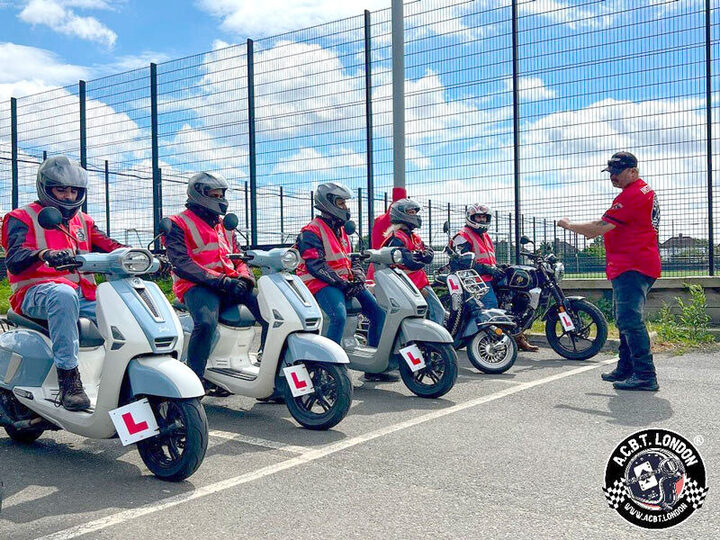
A mutual friend put me in touch with Joe who, along with his wife Lisa, runs ACBT London Rider Training. Their school is in Kidbrooke, south east London, a cycle ride from my home so an easy choice. I met with Joe and it quickly became obvious that here was someone on a mission, a mission to provide training that will help riders become safer on the road. His enthusiasm for the task is infectious.
Not many people run a training school hoping to become super rich. There are many outgoings, costs and capital expenditure.
Outgoings
Bikes which include auto & manual 125s, plus bigger 500s for the Direct Access. Oh, there is also a moped required, ACBT have an electric version, more of that later.
Riding gear in the necessary variety of sizes.
Radios so the instructors can communicate with riders.
Premises (car park) and let’s not forget our favourite thing, insurance. There are two companies that offer cover, therefore competitive quotes do not exist.
All the above plus working with DVLA. You gotta wanna do it.
Chat
Our chat covered many aspects of training and riding on our roads.
Who comes on the CBT? Clearly there are many delivery riders. Many will have ridden before and are capable of getting a pizza or whatever to your door very quickly, but also need some new riding behaviours instilled to make them safer and legal. At the other end are the people who are completely new to the game and require a fair bit more initial rider training.
Joe offered me the opportunity to go on a course so that I could experience everything that is taught on the course. I have to admit the prospect was quite exciting, so I was booked on.
One needs to be committed to doing CBT. Not just the cost but we needed to be there at 8.00 and that was in the morning! It is also quite a long day, there is much to learn. At least it was a lovely sunny day.
It is emphasised that the course is not a pass/fail thing but if the instructor deems a rider is not safe then no certificate will be handed over until further training has been successfully completed. So, in reality it is pass/fail on the day but I guess the idea is to keep things relaxed with pressure off for people going on the road for the first time.
Five Elements
There are five elements to the CBT which all need to be successfully completed:
1. Admin & eyesight check
2. Learning about the bike, controls, safety checks
3. Riding training, manoeuvring, emergency stop
4. Theory stuff, rules of the road and keeping safe
5. Rider training on the road
Three other “students” were booked in and, a little disappointingly, none were potential delivery folk, all had ambitions to either commute or go further down the road of becoming riders of bigger bikes and all had some riding experience. One was doing the CBT for the second time, his first having run out. He hadn’t continued riding as the insurance was financially prohibitive, but subsequently had moved to a different area with more affordable quotes.
One guy had ridden a little in Italy and the other in Pakistan where road conditions are a little different.
Our instructor for the day was Sean who shared Joe’s enthusiasm for the training.
I can only think that there are two types of people who teach CBT. Those who are empathetic and wish to impart their knowledge and experience. Then instructors who may have larger egos and want to laud their big bikes and perceived abilities over others.
Clearly Joe and Sean were the former.
Once the admin and intro’s were completed, Sean spent time explaining how the day would work, then proceeded to the stuff that everyone needs to know about entering the world of road riding.
Next, we moved on to the bikes, becoming familiar with controls, on and off stands, essential checks. It turns out that pre-ride checks are part of the Highway Code and are obligatory. Who knew?
Actual Riding
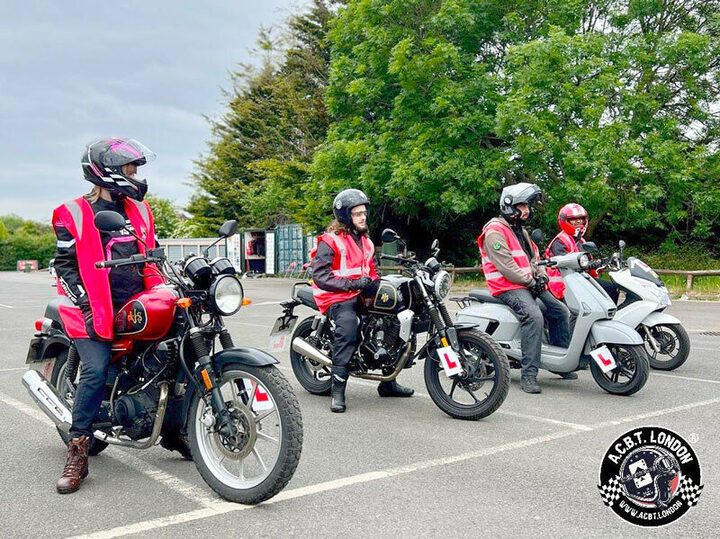
On to the actual riding now. Two of my fellow students were on manual bikes, the other had chosen to learn on an auto scooter and I was allocated the E bike moped.
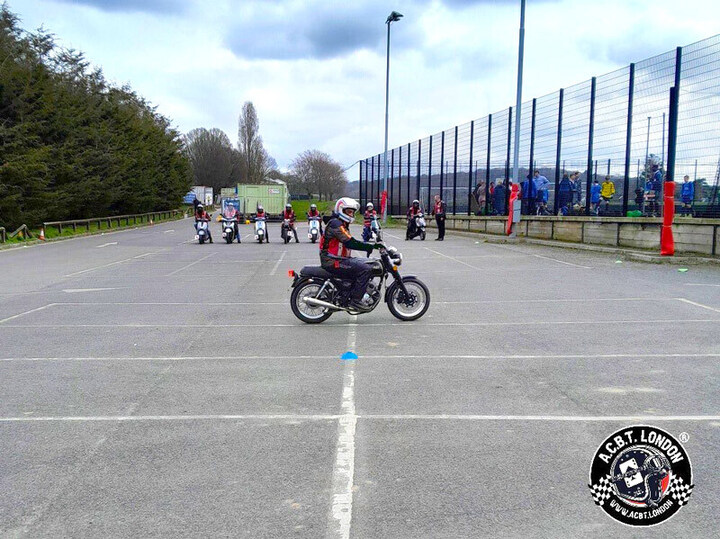
We began by just pulling away and stopping in control, then once we had proved a degree of competency, we moved on to more complicated manoeuvres. The emphasis was on being in control and looking ahead. Left turns, right turns, slalom, figure of 8 followed and we only moved on when everyone was comfortable with each exercise. Lastly, the emergency stop.
After a break we were going out into the big wide world, but not before we'd had a classroom type lesson on The Highway Code and general rules of the road. Sean was asking us questions and blimey I was having to make the grey matter work on some of them. Once he was satisfied we had absorbed most of the lesson, we were deemed ready to head out.
On The Road
Two hours are timetabled for the “on road” section of the training. I thought that sounded a little excessive but it proved to be a well-judged amount of time.
The two guys on the manual bikes went out with Sean, whilst myself and Abbas on the autos were with Joe. The way it works is that the instructor rides behind you, giving directions and advice via the one way radio. After a few basic junction manoeuvres on small quiet roads we were tasked with practising U turns and emergency stops. Only then were we taken on larger busier roads. The two London boroughs that we were going in and out of have different speed policies so we were frequently going from 20 to 30 mph and vice versa.
Even on an E moped it can be a challenge to stop the speed creeping up over 20 mph. My other challenge was feeling embarrassed at holding cars up and allowing myself to gravitate to the left of the carriageway, so as to allow people to overtake. I was reminded a few times before I stuck to the middle of my lane. Relieved only when we could turn off or stop with traffic.
To begin with Abbas was struggling a bit with confidence as it was a whole new experience. His speed was a bit down and remembering to cancel indicators was a small issue, but Joe was there to remind him and encourage him to go a little quicker and after a while he got into the flow of it.
The two hours were over much quicker than I had expected and we headed back to the school.
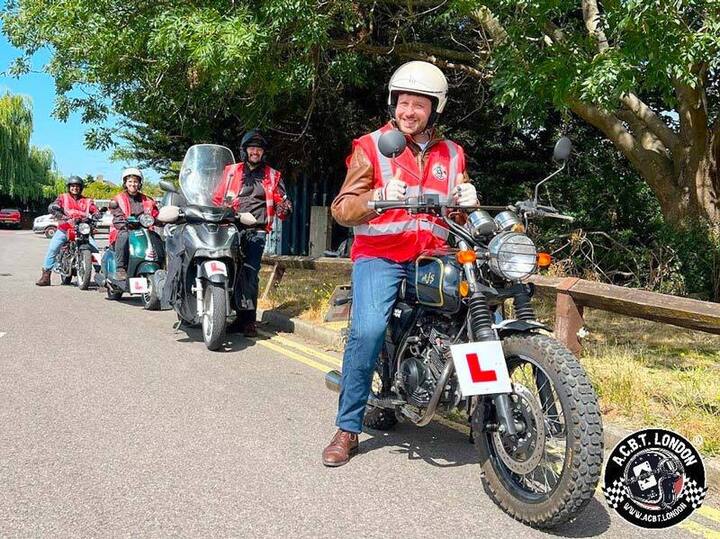
There was a debrief and then it was time for me to leave. Huge disappointment as the other three stayed on to get their certificates. I confess to feeling a little envious that I left empty handed.
However, as I reflected over the experience, despite not receiving the recognition I clearly craved. The training for me was interesting in that it reaffirmed things that I already do and know. But more than that it reinforced some of the things we all need to do. For instance: in the dark distant past, the Highway Code mantra was “Mirror, signal, manoeuvre”. The “mirror’ has been replaced with “Observation”. More apt for motorcyclists but doesn’t quite trip off the tongue so well. Noticing what other people are doing, or are likely to do, is what keeps us so much safer and the positive reinforcement that we 'learners' received all day, both in the car park and on the road, particularly when doing the “lifesaver” look over the shoulder, started the process of instilling that behaviour.
A friend told me of his and his son’s recent experience doing CBT with a different school. The son is 18 and completely inexperienced and the instructor was shouting at him when teaching clutch control. The lad did not enjoy the time at all. Will his dad go back to do his DAS with that school? Reckon not.
Obviously, my perspective of the training will be different to someone who wants/needs their CBT certificate to get on the road but none the less, from my observation of the others taking part, it was an interesting and engaging experience with the emphasis on keeping safe. Instilling good riding behaviours at the start will help people survive the rigours of the road. Encouraging people to be involved in their riding will help ensure they are better riders. I must confess that I have had some rider training before. When I was in Junior School I did the Cycle Proficiency Test. Aspects of that afternoon have stayed with me, I’m anticipating that some of Sean and Joe’s lessons will stay with me too.
How interesting – very many thanks to Dave for this illuminating story about what the modern day CBT involves – sounds as though he had a great and valuable experience. Have you done one recently or have any memories of yours? We'd love to hear about it at
[email protected] or on Facebook.



 EN
EN TH
TH UK
UK